
The Work of Sharing a World

by Joseph Murphy, Director of Strategic Partnerships
On August 6, twelve people made their way through a hot, muggy evening to Queens Public Library’s Ridgewood branch. The stately brick building, with its tall arched windows and iron fence, sits on Madison Street near the Forest Avenue subway station. Inside, snacks from the Friends of Ridgewood Library waited on a table, and chairs had been arranged in a circle.
The question before the group—Can we disagree without falling apart?—sounded large enough to belong to legislatures, courts, and newspaper columns. Yet here it was in an ordinary room among participants holding copies of a poem.
The conversation began with Robert Frost’s 1914 poem “Mending Wall.” In it, two neighbors meet each spring to repair the stone wall between their properties. One doubts that the wall is needed; the other repeats a saying inherited from his father: “Good fences make good neighbors.” Their disagreement remains, as does their yearly appointment at the wall. This is the poem’s curious arrangement. The neighbors do not resolve their difference, but neither do they abandon their relationship. They return to the same boundary and undertake the same work together. Perhaps living with others depends less on reaching agreement than on returning to the work a shared life requires.
Participants read the poem twice, lingering over its images and language before bringing in their own experiences. Some understood the wall as a boundary that protects a relationship, while others noticed the forces that keep knocking it down. Was rebuilding an act of care, an unexamined habit, or a way of preserving the conflict itself? The room never settled on a single answer. People kept returning to the neighbors working side by side: the repair seemed to hold their relationship together even as the wall divided them. A shared poem gave the group somewhere to put its differences and enough time to examine them.
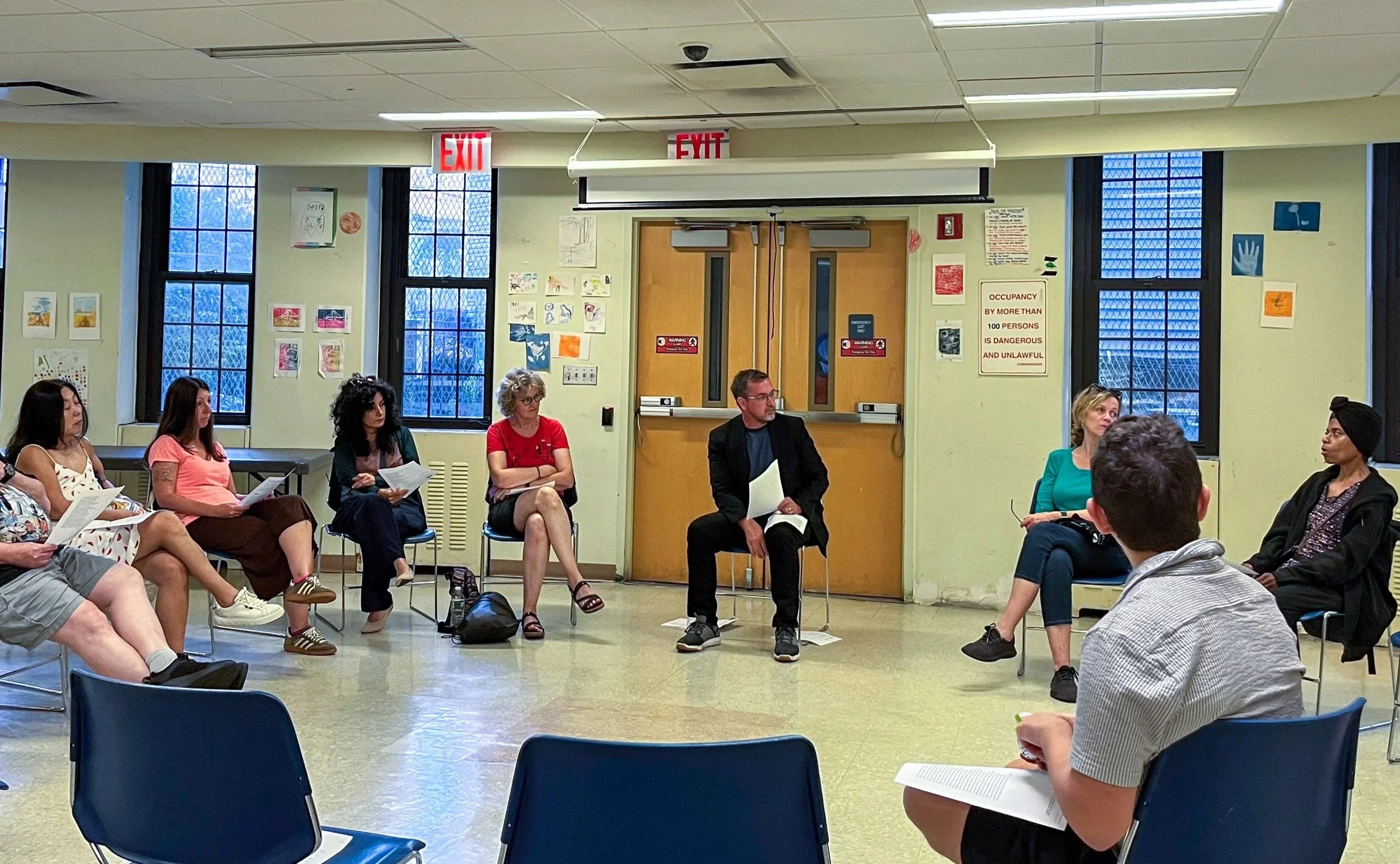
Gradually, the conversation moved from Frost’s neighbors to relationships in participants’ own lives, then to the communities around them. Near the scheduled end, someone asked who the “we” was in the evening’s central question. Did it mean the people in the room? New Yorkers? A democratic society? Only then did the state of the country enter the discussion. By that point, however, the group had already been practicing one of democracy’s quieter disciplines: listening closely enough to discover that another person had not read the same words in quite the same way.
Frost’s wall kept the large question within reach. Before deciding what boundaries mean in public life, participants could examine one boundary between two neighbors; before confronting the country’s divisions, they could disagree about the peculiar ritual that brought these men together each spring. The poem offered everyone a common object of attention, something they could return to when their readings diverged. That return echoed the annual repair at the center of the poem. In each case, disagreement did not end the encounter; the work continued in its presence. The poem settled nothing, nor did it make conflict disappear. It changed the pace of the conversation, allowing the question of democratic life to acquire the texture of ordinary relationships.
The gathering grew from a partnership between Humanities New York and Queens Public Library’s civic engagement team, led by Director of Civic Engagement Scott McLeod and Assistant Director of Civic Engagement Jerrie Grantham. Together, the partners shaped The Future of Democracy: Conflict, Disagreement, and Civic Life around questions that library branches wanted to explore.
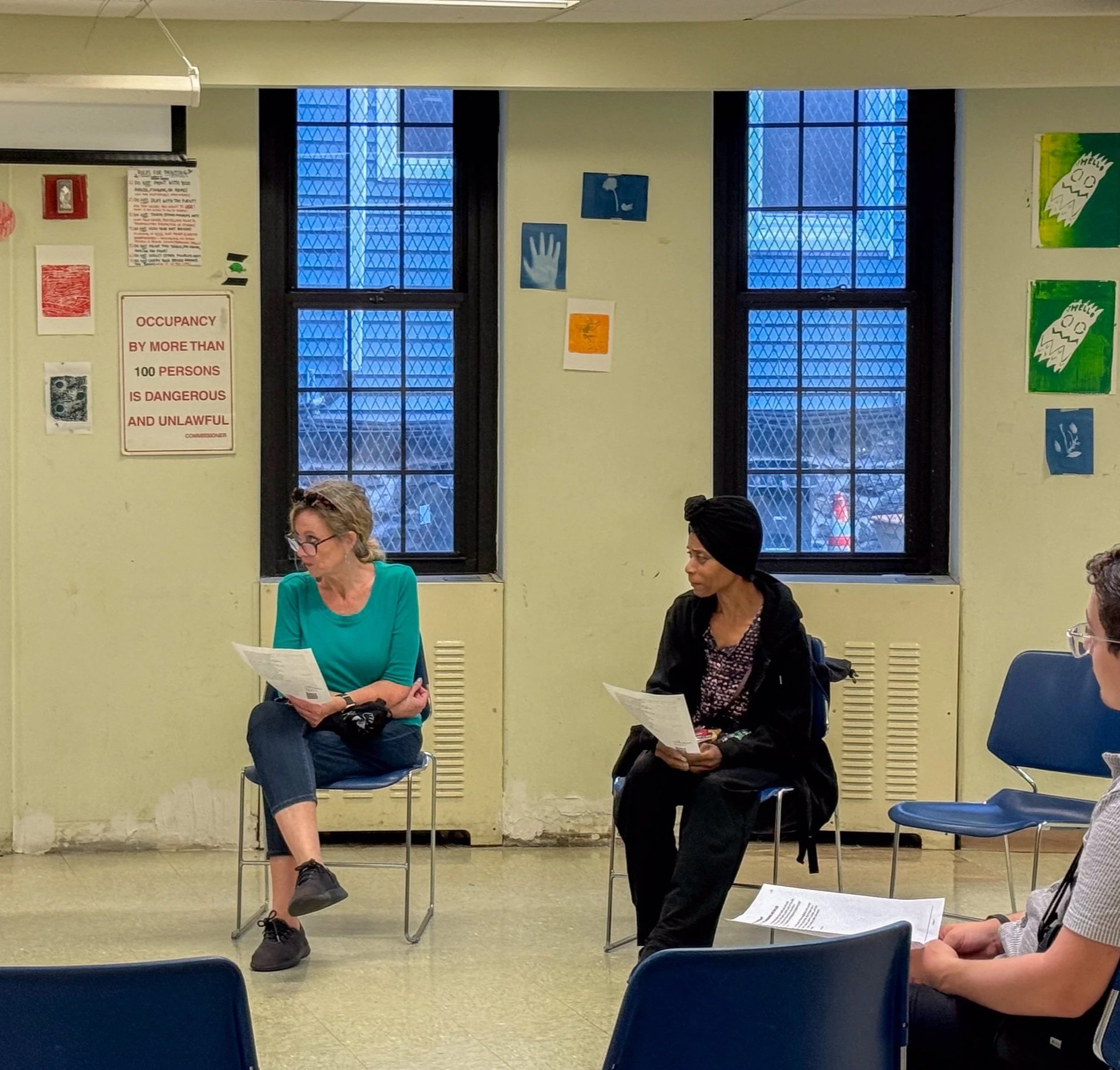
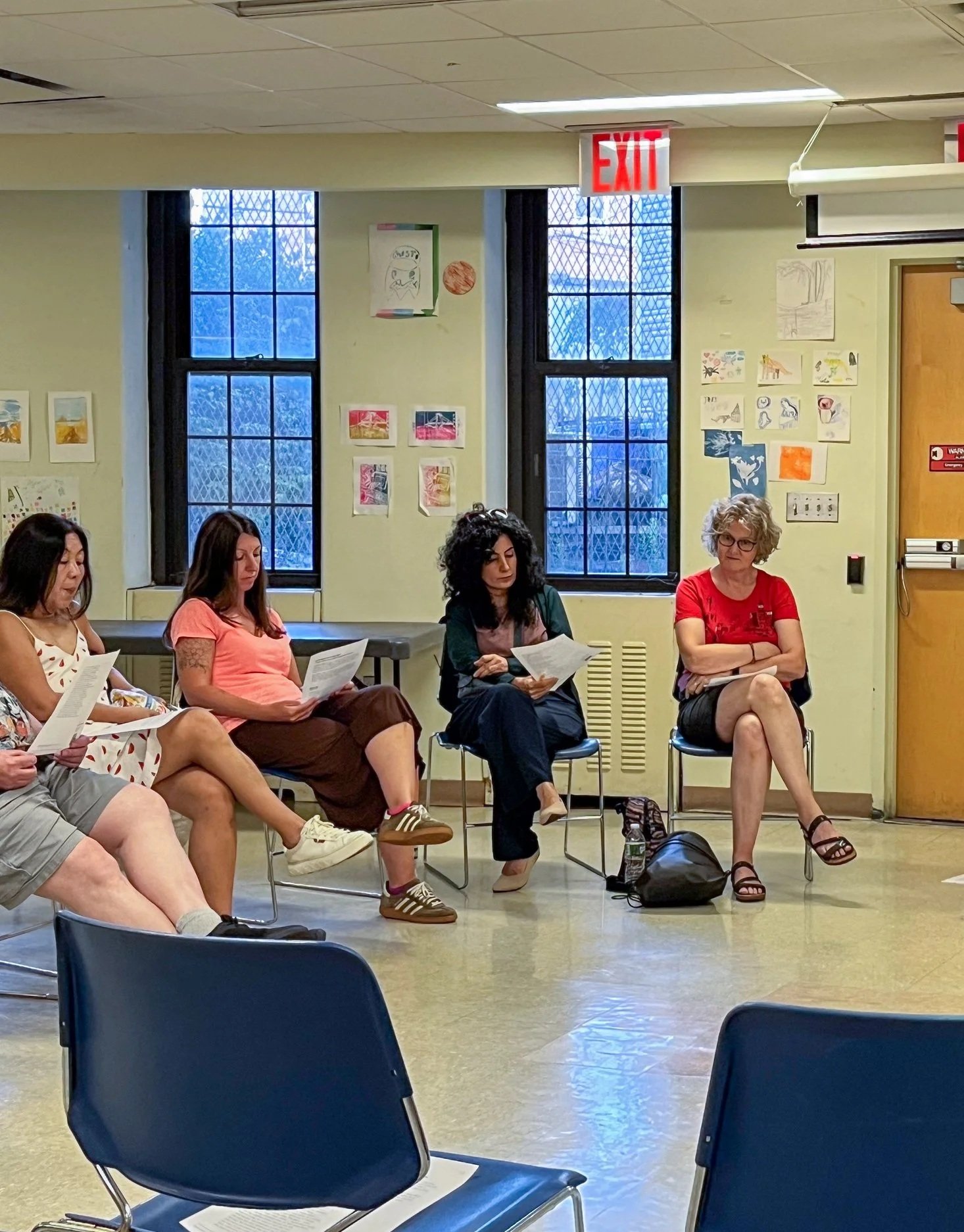
At Ridgewood, the partnership was visible in the room itself. The Friends group provided the snacks, the library offered a familiar neighborhood setting, and HNY supplied the poem, facilitation, and conversation design. Democracy can sound abstract when named from a distance. Here it looked like twelve people sitting in a circle on a humid evening, reading the same lines and finding different things in them.
Libraries are especially suited to such encounters because they already belong to the daily life of a place. People enter them for books, information, assistance, shelter, or simply somewhere to be. Every branch also carries its own relationships and local knowledge. What facilitators and partners learn at Ridgewood can shape later conversations, help prepare new facilitators, and inform resources shared through In Common: A Humanities Forum. The format will travel, but it will also change as new communities make use of it.
Time ran out just as the exchange was opening further. No consensus had formed, and people wanted to keep going.
The unfinished ending felt appropriate. Sharing a world means living with arguments we cannot settle. The challenge is to build habits—and find places—that allow us to return to them. On a humid night in Ridgewood, twelve people did just that.
The conversation continues at QPL Ridgewood on September 3 with a discussion about whether offense is a threat—or a necessity—in a free society.